How to Use Tarot Cards for a Timeline Reading (And Find Out Where You Are Right Now)
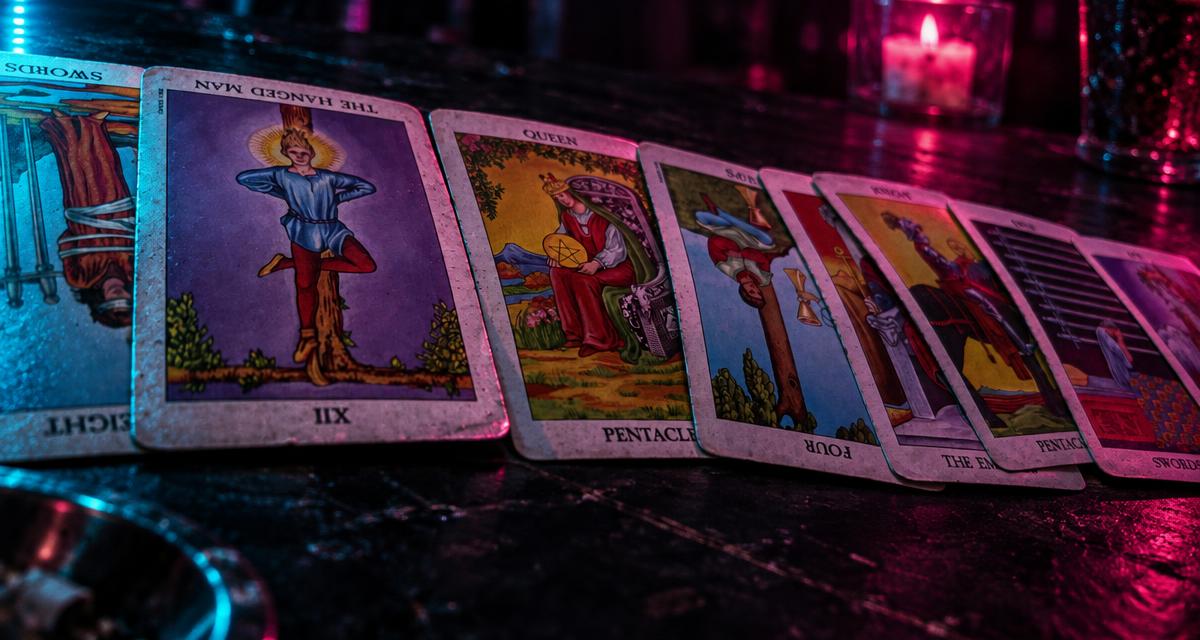
One of my favourite ways to use tarot is to ask the cards for a timeline of events, rather than simply asking what will happen next.
I actually find this method much more useful when I want to understand how a situation is developing over time. It could be about a relationship, someone I'm interested in, a job I've applied for, or pretty much any situation where I'm waiting to see how things unfold.
The interesting part is that I also use a second tarot deck to identify exactly where I am on that timeline right now.
This allows me to look at the events that have already happened, compare them with what I know, and get a clearer picture of what might happen next.
And if the past events don't match the cards? Well, that's usually a sign for me to take a break and try again later.
Here's how I do it.
Why I Prefer Tarot Timeline Readings Over Asking What Happens Next
Let's say you're asking your tarot cards a question like:
"What will happen next between me and this person?"
You pull five or six cards and try to interpret them as a sequence of events.
But there's a problem.
How do you know where the timeline actually starts?
Does the first card represent something that will happen tomorrow? Next week? Or could it be describing something that has already happened?
I've noticed that when I ask tarot cards what will happen next, the first few cards sometimes seem to describe events that have already taken place.
This can make the entire reading confusing, especially if you're trying to understand the order of events.
That's why I started using a slightly different method.
Instead of asking only about the future, I ask the cards to show me the entire timeline of a situation, including the past, present and future.
Step 1: Ask Your Tarot Cards to Show You a Timeline
First, I focus on the situation I want to explore.
I might ask something like:
"Show me the timeline of events between me and this person, from the beginning until the situation reaches its next major turning point."
Or, if it's about a job application:
"Show me the timeline of events surrounding this job opportunity, including what has already happened and what is likely to happen next."
I then pull a series of tarot cards, placing them in the exact order they appear.
Personally, I only use jumpers, meaning cards that spontaneously jump or slide out of the deck. Sometimes the deck naturally stops as I'm flipping through it, and I take that card too.
I don't decide in advance how many cards I need. I simply continue until I intuitively feel that the timeline is complete.
The important thing is that the cards are placed in chronological order.
The first card represents the earliest event in the timeline, and each following card represents the next stage of the situation.
I don't assign specific dates to the cards at this point. I'm interested in the sequence of events, not necessarily whether something happens on a Tuesday or three weeks from now.
Step 2: Use a Second Tarot Deck to Find the Present Moment
This is where my method becomes a little different from a traditional tarot timeline spread.
Once I've laid out the entire timeline, I take a completely separate tarot deck.
I focus on the timeline in front of me and ask:
"Where are we on this timeline right now?"
Or:
"Which event or stage on this timeline represents the present moment?"
I then pull one or more cards from the second deck.
These cards act as my present moment marker.
For example, let's say my original timeline contains twelve cards.
I pull The Tower and The World from my second deck as my present moment marker.
I then look at the original timeline to identify where those energies or events appear.
If they correspond to cards seven and eight, for example, I interpret that as an indication that we're currently around that stage of the timeline.
This means the earlier cards represent events that should already have happened, while the remaining cards describe the potential developments ahead.
Instead of guessing where the future begins, I now have a specific reference point.
Step 3: Check Whether the Past Events Match Reality
For me, this is one of the most important parts of the entire process.
Once I've identified the present moment, I go back and examine the cards that appear before it.
Do they describe events that I already know have happened?
Does the sequence make sense?
Are there recognisable turning points, changes in circumstances, periods of waiting, conflicts or opportunities that match the actual history of the situation?
For example, imagine I'm doing a tarot timeline reading about a job application.
The first few cards might suggest:
- Ace of Pentacles: A new opportunity appears.
- Eight of Wands: Communication moves quickly.
- Three of Pentacles: Discussions, interviews or an evaluation process.
- The Hanged Man: The situation slows down or becomes uncertain.
- Justice: A decision is being made.
If I know that I applied for a job, had several interviews and then experienced a period of silence, I can compare those events with the timeline.
If the sequence matches what has already happened, I feel more confident that the reading is connected to the situation I'm asking about.
But if the cards describe a completely different sequence of events, I don't automatically try to make them fit.
And that's an important part of my method.
Step 4: What I Do When the Timeline Doesn't Match
Sometimes I get a timeline that simply doesn't make sense.
The past events don't match what I know has happened, the sequence seems wrong, or the cards feel disconnected from the question.
When this happens, I usually take it as a sign that I haven't connected with the right energy.
Maybe I'm not focused enough. Maybe I've been doing too many readings. Or maybe it's simply not the right moment to ask.
I've noticed that my tarot readings tend to be much clearer when I'm in a deeply meditative state.
I can often even feel the difference physically when handling my tarot deck. When the cards glide smoothly between my fingers, the readings usually feel much clearer. When the cards become sticky or difficult to separate, the messages often become confusing or contradictory.
So if a timeline doesn't match the events I already know about, I don't keep pulling more and more cards trying to fix it.
I put the deck away, take a break and come back later.
Sometimes I also hold my deck close to my heart for a while to reconnect with my intuition.
For me, it's much better to return with a clear mind than to force a reading that isn't flowing naturally.
Step 5: Interpret the Events That Are Still Ahead
Once I've identified the present moment and compared the earlier cards with what has already happened, I turn my attention to the remaining cards.
These represent the possible future developments in the situation.
And this is where I find timeline readings particularly useful.
Instead of getting a collection of cards that might describe the past, present or future, I now have a chronological sequence with a clearly identified present moment.
I can look at how one event might lead to another.
For example, if the remaining cards are:
- Four of Swords
- Ace of Swords
- Knight of Cups
- The Chariot
I might interpret this as a period of inactivity or reflection, followed by clarity or communication, an emotional approach, and finally some kind of decisive movement.
Of course, the interpretation depends on the question and the surrounding cards.
But the advantage is that I can read these cards as a developing story rather than four unrelated messages.
Why I Use Two Different Tarot Decks
You might wonder why I don't simply use the same tarot deck to identify the present moment.
For me, using two separate decks helps me keep the two intentions apart.
The first deck has one purpose: to show the entire sequence of events.
The second deck has a completely different purpose: to identify where the situation currently stands within that sequence.
I find that separating these two questions helps me stay focused.
It also prevents me from having to decide beforehand which card represents the present.
I let the second deck provide that reference point.
It's a method that feels very natural to me, especially because I prefer working intuitively rather than following a rigid tarot spread with predetermined card positions.
Can Tarot Really Show a Timeline of Future Events?
From a spiritual perspective, tarot is often understood as a way of reading the energies and potential developments surrounding a situation.
Personally, I see a tarot timeline as a picture of how events may unfold based on the current energy.
I don't necessarily believe that every future event is fixed or that nothing can change.
People make decisions. Circumstances change. New information appears.
But I find that looking at the entire sequence gives me a much better understanding of the situation than simply asking what will happen next.
The past events also give me something concrete to compare the reading with.
That doesn't mean a matching past automatically proves that the future cards will come true. But it helps me evaluate whether the reading feels coherent, rather than accepting every interpretation without questioning it.
And that's something I really appreciate about this method.
My Advice for Trying a Tarot Timeline Reading
If you want to try this technique yourself, I would recommend starting with a situation where you already know quite a lot about what has happened.
It could be a relationship, a previous job application or another situation with several recognisable events.
Ask your first deck to show the full timeline, without restricting the reading to future events.
Lay out the cards in the order they appear.
Then take a second deck and ask it to identify the present moment.
Compare the earlier cards with the actual events before interpreting the rest of the timeline.
And most importantly, don't try to force the cards to match.
If the timeline doesn't make sense, it's perfectly fine to put the cards away and try again another day.
I also recommend writing down your interpretation before future events happen. That way, you can look back later and see how your reading actually compared with reality, rather than unintentionally adjusting the meaning afterwards.
Final Thoughts: Let Tarot Tell the Whole Story
One thing I've learned from reading tarot is that sometimes the question itself makes a huge difference.
Asking "What happens next?" can give you useful insights, but it doesn't always tell you where the reading begins.
By asking for the entire timeline and then using a second deck to identify the present moment, I feel that I get a much clearer overview.
I can see what has already happened, where the situation seems to be right now, and what the next stages might look like.
For me, it's like looking at a map instead of only asking what's around the next corner.
And when the cards flow naturally, the timeline matches the events I already know about, and the interpretations come to me without effort, that's when I feel most connected to my tarot practice.
Sometimes, instead of asking tarot to show you the future, it makes more sense to ask it to show you the whole story.