How to Ask Follow-Up Questions in Tarot for More Accurate Readings
# How to Ask Follow-Up Questions in Tarot for More Accurate Readings
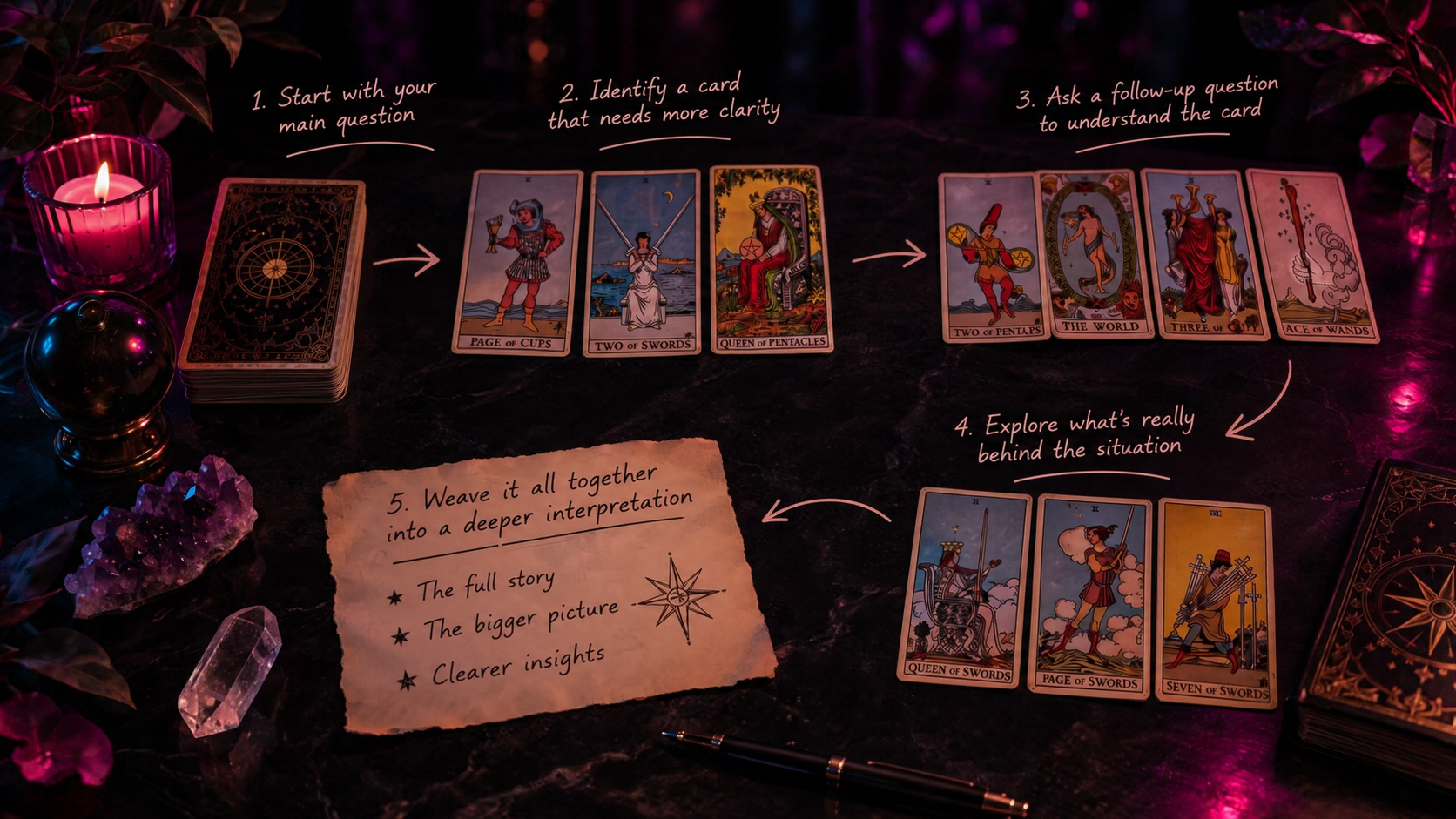
One of the most useful techniques I've developed as a tarot reader is asking very specific follow-up questions. I rarely stop at just one question, especially when the cards give me an answer that could be interpreted in several different ways. Instead, I keep narrowing down the question until I get a much clearer picture of what the cards are trying to tell me. Sometimes, a single question can lead to four or five follow-up questions. And that's completely intentional.
The reason is simple: tarot cards represent broad themes and symbols, not detailed explanations of specific situations. A card like Two of Swords can mean several different things. Without additional context, how do you know which meaning applies to your particular question? This is where follow-up questions become incredibly useful.
In this article, I'll explain how I use follow-up questions in tarot, how I narrow down the meaning of individual cards, and how I connect several readings to build a more detailed interpretation.
Why I Ask Follow-Up Questions in Tarot
Let's say you ask your tarot cards: "How does this person feel about me?"
You pull three cards:
- Page of Cups
- Two of Swords
- Queen of Pentacles
At first glance, you might interpret this as someone who has romantic feelings but is hesitant or emotionally conflicted. Page of Cups often represents romantic interest, emotional curiosity or the beginning of feelings. Queen of Pentacles can represent stability, security, commitment or an important person connected to someone's domestic life.
But what about Two of Swords? This card has many possible meanings, and the surrounding cards don't necessarily tell you exactly which one applies.
Two of Swords can represent:
- Indecision or difficulty making a choice.
- Emotional avoidance or refusing to acknowledge certain feelings.
- Being caught between two options.
- Trying to maintain peace by not taking action.
- A temporary stalemate where nothing is moving forward.
- Protecting yourself emotionally.
- Not having enough information to make a decision.
- Trying to balance conflicting thoughts or priorities.
These interpretations are all possible, but they describe quite different situations. And I don't want to simply pick the interpretation that sounds most likely. I want to ask the cards what Two of Swords specifically means in this reading.
Step 1: Ask What a Specific Tarot Card Means in Context
Instead of starting a completely new reading, I focus on the card I want to understand better. In this example, I ask: "What does Two of Swords represent in this situation?"
Let's imagine I get these four cards:
- Two of Pentacles
- The World
- Three of Cups
- Ace of Wands
Now I have much more information to work with. Two of Pentacles suggests juggling different priorities, responsibilities or situations. The World often represents completion, the end of a cycle or a significant life transition. Three of Cups can represent social connections, friendships, celebrations or spending time with other people. Ace of Wands represents passion, attraction, new beginnings and the desire to take action.
Together, these cards might suggest that the hesitation represented by Two of Swords isn't necessarily about a lack of feelings. Instead, the person could be trying to balance several different aspects of their life. Perhaps they're going through the end of an important chapter while also wanting to explore new social or romantic opportunities. The World could indicate that something is coming to an end, while Ace of Wands suggests a desire for a passionate new beginning.
Suddenly, Two of Swords becomes much more specific. It's no longer just about someone being indecisive. It could represent a person who is trying to navigate a major transition while balancing existing responsibilities with new desires. But I'm not necessarily finished yet.
Step 2: Ask Why the Situation Is Complicated
Now that I have a possible interpretation, I might want to understand what is actually causing the hesitation. So I ask another follow-up question: "Why is this situation a problem for this person?"
Let's imagine I pull:
- Queen of Swords
- Page of Swords
- Seven of Swords
This combination introduces another layer to the reading. Queen of Swords can represent a person who is emotionally guarded, independent, critical or very clear about their boundaries. In certain contexts, it can also represent a former partner, particularly someone who has become emotionally distant after a difficult relationship. Page of Swords can represent curiosity, observation, suspicion or someone keeping an eye on a situation. Seven of Swords often represents secrecy, discretion, hidden intentions or avoiding confrontation.
Looking at these cards together, one possible interpretation is that the person feels they need to be careful because someone else is watching or questioning their actions. Perhaps there's a partner or former partner who is suspicious or jealous. Maybe the person wants to keep certain feelings or plans private to avoid conflict.
And now something interesting happens. The previous follow-up reading suddenly becomes even more relevant.
Remember The World? That card suggested the completion of a cycle or the ending of something significant. Combined with Queen of Swords, Page of Swords and Seven of Swords, I might interpret the situation as involving a relationship that is ending or has already ended, but where emotional complications still exist. For example, a former partner might still be jealous or suspicious, making it difficult for the person to move forward freely.
This is only one possible interpretation of the cards, but it shows how each follow-up question can add another layer of context.
Step 3: Connect the Answers Instead of Treating Them as Separate Readings
This is probably the most important part of my method. I don't treat every follow-up question as a completely separate tarot reading. I see them as different parts of the same conversation.
The original question was: "How does this person feel about me?"
The first cards suggested romantic curiosity, hesitation and a need for stability. The second reading explored the meaning of that hesitation and introduced themes of competing priorities, completion and new beginnings. The third reading explored why the situation might be complicated and introduced themes of boundaries, observation and secrecy.
When I connect these readings, I can build a much more detailed interpretation. For example:
The person may feel romantic attraction but is hesitant to act because they're balancing several aspects of their life. They may be going through the end of a relationship or another significant transition, while wanting to explore a new romantic connection. However, concerns involving another person, possibly a jealous or suspicious former partner, could make them cautious about revealing their intentions.
That's a much more detailed interpretation than simply saying: "This person has feelings for you but is indecisive."
And that's exactly why I use follow-up questions.
Step 4: Keep Narrowing Down the Question
Sometimes I stop after two or three questions. Other times, I might ask four or five follow-up questions about one particular detail.
For example, after the previous reading, I might ask:
- What exactly is this person trying to keep private?
- What is preventing this person from moving forward?
- What needs to change before this person feels comfortable taking action?
Notice how each question becomes more specific. I'm not repeatedly asking the same general question and hoping for a different answer. I'm following a particular thread that has already appeared in the cards.
I think of it almost like investigating a story. The first reading gives me the main theme. The next reading explains one important detail. The following reading explores the reason behind that detail. And eventually, I have a much more complete picture of the situation.
Why Specific Questions Can Give More Precise Tarot Answers
Tarot cards have a limited symbolic vocabulary. There are 78 cards in a traditional tarot deck, and each one can represent several different concepts depending on the question and the surrounding cards.
For example, The World might represent:
- The completion of an important chapter.
- The end of a relationship or situation.
- Personal growth and achievement.
- Travel or international connections.
- A feeling of fulfilment.
- Moving into a new phase of life.
If I simply pull The World and ask what will happen next, I have several possible interpretations. But if I ask "What is this person trying to bring to an end?" and The World appears alongside Eight of Cups and Justice, the context becomes much more specific. I might interpret those cards as someone considering leaving an existing situation and making an important decision.
The more precisely I formulate my question, the more precisely I can interpret the symbols in relation to that question. For me, the secret isn't necessarily pulling more cards. It's asking better questions.
How I Avoid Getting Confused by Too Many Follow-Up Questions
There's one important thing I've learned from doing a lot of tarot readings. More questions don't always mean better answers.
I've noticed that when I do too many readings in a row, my tarot deck sometimes starts feeling tired. The cards become difficult to handle, jumpers don't appear as naturally, and the answers can become contradictory or confusing. When this happens, I usually stop.
I don't want to keep asking questions just because I'm trying to get a particular answer. I also try to distinguish between asking a genuinely new follow-up question and simply repeating a question because I didn't like the previous result. Those are two very different things.
A useful follow-up question explores something specific that appeared in the previous reading. For example: "What does Seven of Swords represent here?" That's different from asking "Does this person have feelings for me?" five times in a row.
The first question helps me explore the symbolism in more detail. The second might simply create confusion, especially if I keep interpreting every new spread as a completely separate answer.
I also try to remember that a detailed interpretation is still an interpretation. The cards can support several possible narratives, and asking more questions doesn't automatically prove which one is correct.
Using ChatGPT to Analyse Tarot Follow-Up Questions
Another thing I like doing is using ChatGPT to help me organise the different layers of a tarot reading. After asking several follow-up questions, I might have 15 or 20 cards describing different aspects of the same situation. It can become difficult to keep track of how everything connects.
So I sometimes paste the entire sequence into ChatGPT and ask:
"Analyse these tarot readings as one connected sequence of questions and answers. Explain how each follow-up reading adds context to the previous one, and identify the strongest recurring themes."
I can also ask ChatGPT to create a table showing:
- The original question.
- The cards that appeared.
- The specific follow-up question.
- The new information suggested by those cards.
- How the interpretation developed across the readings.
This makes it easier to see whether the cards are building a consistent narrative or whether I'm starting to make assumptions that aren't clearly supported by the symbolism. I find this particularly useful when I've asked several follow-up questions about the same card. It helps me see the bigger picture without losing track of the original question.
My Advice for Asking Better Tarot Follow-Up Questions
If you want to try this method, I would recommend starting with a relatively simple question. For example: "What is the main energy surrounding this situation?"
Pull a few cards and look at the overall message. Then identify the card that feels the most ambiguous or important. Instead of guessing what it means, ask: "What does this card specifically represent in this situation?"
Interpret the new cards in relation to the original question. If the answer introduces another important detail, you can explore that too. But try to keep the questions connected. Don't jump between completely different subjects, and don't lose track of what you originally wanted to understand.
I also recommend writing down the exact questions and cards in the order they appeared. This makes it much easier to go back and understand how you arrived at your interpretation. And if the answers start becoming confusing, take a break. You don't need to solve the entire situation in one tarot session.
Final Thoughts: Tarot Is a Conversation, Not Just a Question and Answer
One of the things I love about tarot is that it doesn't have to be limited to a single question followed by a few cards. For me, tarot is much more like a conversation. I ask a question, receive a symbolic answer, and then explore the parts I want to understand better.
Sometimes one question is enough. Other times, I need several follow-up questions before the bigger picture starts making sense. And because tarot cards represent broad themes rather than detailed explanations, I think learning how to ask specific questions is one of the most valuable skills you can develop as a reader.
You don't necessarily need to memorise more card meanings or use complicated spreads. Sometimes, you simply need to become better at asking the next question.
The more precisely you explore the symbolism, the more detailed and meaningful your tarot interpretations can become.