How to Use ChatGPT for Tarot Readings and Become a Better Tarot Reader
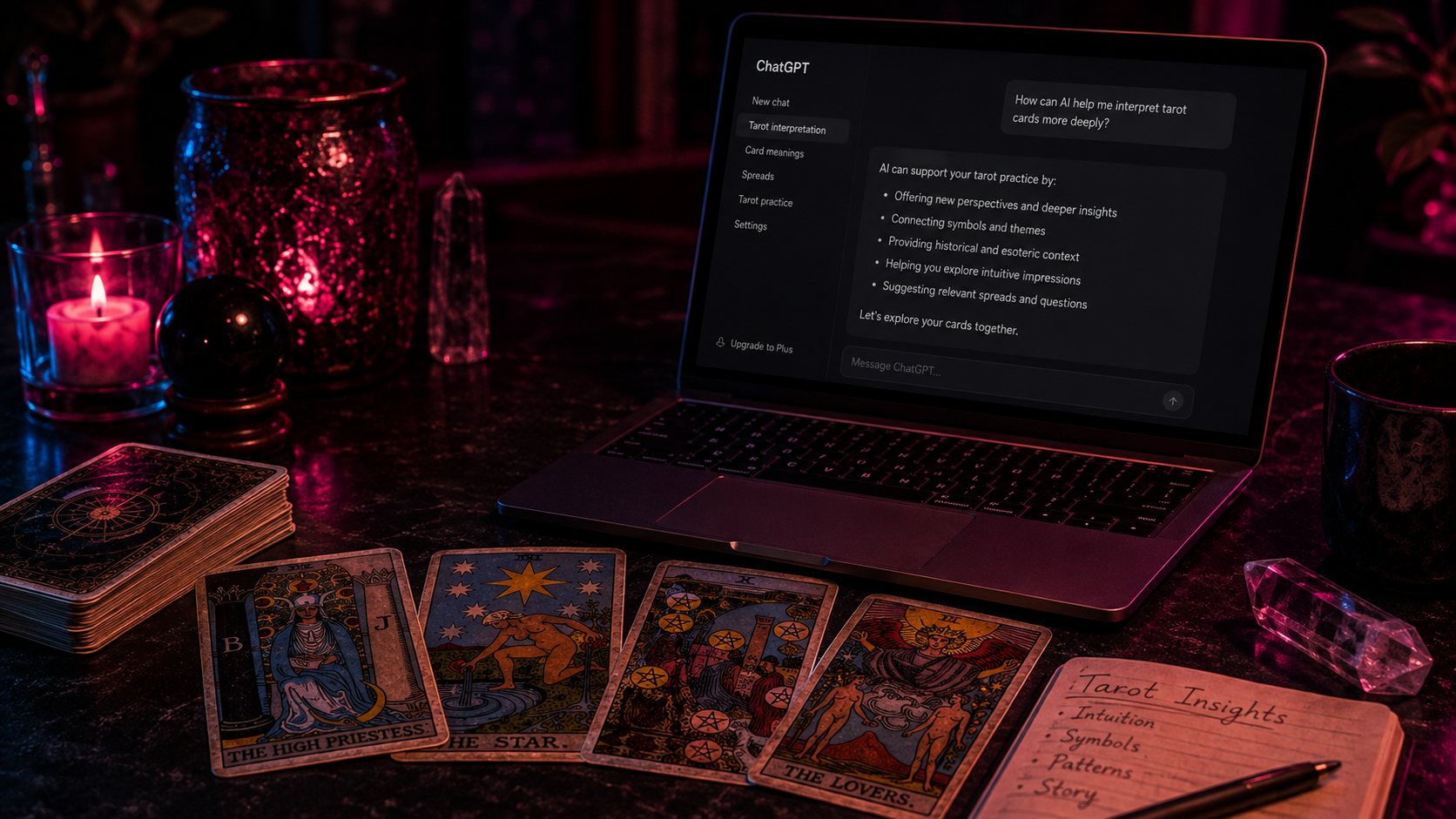
# How to Use ChatGPT for Tarot Readings and Become a Better Tarot Reader
I've been reading tarot for quite some time, and one of the most useful tools I've discovered for improving my readings is actually ChatGPT.
Not because I want AI to read the cards for me. I already know the traditional tarot card meanings, and I rely a lot on my own intuition when interpreting them.
What I find particularly useful is something else: using ChatGPT to analyse multiple tarot readings, identify recurring patterns and organise the information in a way that would be difficult to do manually.
If you've ever done several tarot readings about the same situation over a longer period of time, you probably know how confusing it can become.
One reading might suggest communication, another might indicate delays, and a third might show a major turning point.
But what if you could look at all those readings together instead of trying to interpret each one separately?
That's exactly what I use ChatGPT for.
Why I Started Using ChatGPT for Tarot Readings
When I read tarot, I often return to the same subject over time.
It could be about a relationship, a job opportunity, a particular person or a situation that is developing over several weeks or months.
Sometimes I do multiple readings about different aspects of the same situation.
For example, I might ask:
- What is happening in this situation right now?
- What is causing the delay?
- What is likely to happen next?
- What is the other person's perspective?
- How might the situation develop over the next few weeks?
Each reading gives me a different piece of information.
The problem is that after doing many readings, it becomes difficult to remember all the cards, combinations and recurring themes.
And this is where ChatGPT becomes incredibly useful.
Instead of trying to keep track of everything in my head, I can give ChatGPT the results of my readings and ask it to analyse the bigger picture.
1. Use ChatGPT to Identify Patterns Across Multiple Tarot Readings
This is probably my favourite way to use ChatGPT for tarot.
Rather than focusing too much on one individual reading, I like to look at the patterns that appear across several readings over time.
Let's say I've done 15 tarot readings about the same situation during the past month.
Some readings might contain cards like:
- Eight of Wands
- Ace of Swords
- Page of Cups
- Knight of Swords
Other readings might repeatedly show:
- Four of Swords
- The Hanged Man
- Seven of Pentacles
- Eight of Swords
When I look at each reading individually, the messages might seem contradictory.
One reading suggests movement and communication, while another suggests waiting, hesitation or delays.
But when ChatGPT analyses all the readings together, it might identify two very clear recurring themes:
Theme 1: Communication, movement and new developments.
Theme 2: Delays, restrictions and a period of waiting before anything changes.
Suddenly, the readings don't necessarily seem so contradictory anymore.
They could be describing different stages of the same situation.
Instead of asking whether the situation will move forward or remain stuck, I can explore whether the cards repeatedly suggest a period of inactivity followed by communication.
This doesn't mean that the pattern guarantees a particular outcome. But it gives me a much clearer understanding of the overall narrative appearing in my readings.
And personally, I find that much more useful than focusing on one isolated tarot spread.
2. Ask ChatGPT to Create Tables of Recurring Tarot Themes
One of the biggest advantages of using ChatGPT is that it can organise large amounts of information into simple tables.
For example, I can paste several tarot readings into a conversation and ask:
"Analyse all these tarot readings together. Identify the strongest recurring themes, group cards with similar meanings, and create a table showing how frequently each theme appears."
ChatGPT might identify patterns like these:
- Communication: Eight of Wands, Ace of Swords and Page of Cups. Messages, conversations or new information.
- Delays: Four of Swords, The Hanged Man and Seven of Pentacles. Waiting, reflection or slow progress.
- Emotional connection: Two of Cups, The Lovers and Ace of Cups. Attraction, emotional openness or connection.
- Difficult decisions: Justice, Two of Swords and Judgement. Choices, evaluation or important decisions.
- Major changes: The Tower, Death and Wheel of Fortune. Endings, turning points or unexpected developments.
These are just examples, not data from my actual readings.
I can also ask ChatGPT to calculate how often certain cards appear, which combinations repeat, and whether the dominant themes have changed over time.
For example, maybe the earlier readings were dominated by The Hanged Man and Four of Swords, while more recent readings contain more Wands and Aces.
That could suggest a symbolic shift from waiting and inactivity towards movement and new beginnings.
I find this especially interesting when I'm following a situation over a longer period.
3. Look at the Bigger Picture Instead of Expecting Every Reading to Be Perfect
Another reason I like this approach is that I don't necessarily expect every single tarot reading to be 100% accurate.
Sometimes I'm tired. Sometimes I struggle to focus. Sometimes the cards seem to give contradictory answers.
I've written before about how I can physically feel when my tarot deck is flowing naturally and when it seems to need a rest.
When the cards feel sticky or difficult to handle, I often find that the interpretations become less clear.
So rather than giving every reading equal importance, I prefer looking at the strongest recurring patterns.
If a particular theme appears consistently across many readings, while one isolated reading suggests something completely different, I want to understand that difference.
ChatGPT can help me identify which themes are repeated and which appear only occasionally.
Of course, repetition doesn't automatically make a prediction correct. If I repeatedly ask similar questions, similar cards and interpretations may naturally appear.
But looking at patterns can still be valuable for understanding the symbolic messages, checking the consistency of my interpretations and reflecting on how my readings develop over time.
For me, the goal is not to make every reading fit the same story.
It's to understand what the cards are showing collectively, including where they disagree.
4. Use ChatGPT to Analyse How Tarot Readings Change Over Time
This is another technique I find very useful.
Instead of simply giving ChatGPT a collection of tarot readings, I include the date of each reading.
For example:
Week 1: The Hanged Man, Four of Swords, Seven of Pentacles
Week 2: Eight of Swords, Justice, Two of Wands
Week 3: The Magician, Ace of Swords, Knight of Wands
Week 4: Eight of Wands, Page of Cups, The Chariot
I can then ask ChatGPT:
"Analyse how the dominant tarot themes have changed from week to week. Create a chronological table and explain whether the overall narrative appears to be developing in a particular direction."
In this example, ChatGPT might identify a progression from waiting and restrictions towards decisions, initiative and movement.
What I like about this is that it becomes much easier to see the development of a situation.
Instead of remembering dozens of separate readings, I get an overview of the themes appearing at different points in time.
I can also compare the readings with actual events that have happened.
This is particularly useful when I want to evaluate how well my earlier interpretations matched reality.
5. Use ChatGPT to Practise Different Interpretations of the Same Tarot Card
You don't need to do multiple readings to benefit from ChatGPT.
It's also a great tool for learning tarot card meanings and improving your interpretation skills.
Even if you already know the traditional meanings, there are often several ways to interpret the same card depending on the question.
Take Seven of Swords, for example.
It can represent dishonesty, but it can also represent discretion, strategic planning, avoiding confrontation or keeping something private.
I sometimes use ChatGPT to explore these different possibilities.
For example, I might ask:
"Give me ten different interpretations of Seven of Swords in a relationship reading. Include both positive and negative possibilities, and explain how the surrounding cards might change the meaning."
Or:
"Explain the difference between Seven of Swords, Seven of Wands, Five of Swords and Five of Wands when asking about someone's intentions."
This helps me develop a more nuanced understanding of the cards.
I don't want to automatically associate every appearance of Seven of Swords with deception, or every appearance of The Tower with a disaster.
Tarot is much more complex than that.
And the more comfortable I become with different interpretations, the easier it is to recognise which meaning feels relevant during an actual reading.
6. Ask ChatGPT to Compare Different Tarot Spreads About the Same Situation
Sometimes I ask several different questions about the same situation.
One reading might focus on someone's feelings, another on their intentions, and another on the possible outcome.
Rather than interpreting these readings independently, I can ask ChatGPT to compare them.
For example:
"Compare these five tarot spreads. Identify the themes they have in common, explain where they differ, and suggest how they might describe different aspects of the same situation."
This is particularly useful because two readings don't necessarily contradict each other just because they contain different cards.
A reading about someone's feelings might contain the Two of Cups and Ace of Cups.
A reading about their actions might contain Four of Swords and Eight of Swords.
These could be interpreted as emotional openness combined with hesitation or inactivity.
By comparing the spreads, I can explore the relationship between different themes instead of assuming that one reading must be wrong.
I also sometimes ask ChatGPT to give me several alternative interpretations rather than just one.
This helps prevent me from becoming too attached to a particular explanation.
7. Let ChatGPT Do the Data Analysis, Not Replace Your Intuition
This is probably the most important point I want to make.
I don't use ChatGPT because I think AI has a stronger intuition than I do.
And I don't believe that ChatGPT can somehow connect to the energy of my tarot cards.
I use ChatGPT because it's very good at organising information, comparing patterns and helping me explore different interpretations.
My own intuition still plays a central role in my readings.
When I'm in a deeply meditative state, I often get an immediate feeling about what a particular card means in the context of my question.
Sometimes the same card gives me completely different impressions in different readings.
I don't want AI to replace that experience.
Instead, I use it as an analytical tool after the reading.
I select the cards, interpret them intuitively, and then use ChatGPT to help me see the bigger picture.
For me, that's the ideal combination.
Intuition during the reading. Analysis afterwards.
8. My Favourite ChatGPT Prompts for Tarot Reading Analysis
If you want to try this yourself, here are a few prompts you can copy and use.
To identify recurring themes:
"Analyse all the tarot readings I've provided. Identify the strongest recurring themes and create a table showing which cards support each theme. Separate frequently repeated patterns from isolated cards, and highlight any contradictions."
To track developments over time:
"Organise these tarot readings chronologically and analyse how the dominant themes change over time. Identify whether there is a progression from one type of energy or situation to another."
To compare multiple readings:
"Compare these tarot spreads about the same situation. Identify the common themes, differences and possible connections between them. Don't force the readings to agree if they genuinely suggest different things."
To practise card interpretations:
"Give me ten possible interpretations of this tarot card in the context of my question. Include different perspectives and explain which surrounding cards would support each interpretation."
To create a data-based overview:
"Create a table showing how frequently each tarot card appears across these readings. Group the cards by recurring themes, but also show the exact card counts. Identify which patterns appear most consistently."
One practical tip: If you want accurate counts, provide the readings in a structured format with dates, questions and card names.
Also ask ChatGPT to distinguish between the actual number of times a card appears and the number of readings containing that card.
Those are not always the same thing.
And if you're analysing a very large number of readings, it's worth double-checking the counts. AI can make mistakes when processing long lists of information.
Final Thoughts: Tarot Intuition and AI Can Work Really Well Together
I know that some people might find the idea of combining tarot with artificial intelligence a little strange.
Tarot is intuitive, spiritual and personal. ChatGPT is a technology tool that analyses language and information.
But that's exactly why I think they can work so well together.
They serve different purposes.
Tarot gives me a symbolic language to explore situations and possible developments.
My intuition helps me interpret the cards in the moment.
And ChatGPT helps me organise multiple readings, identify recurring patterns and see how the overall narrative changes over time.
I especially appreciate being able to analyse many readings together rather than placing too much importance on one individual spread.
Sometimes the most interesting insights don't come from a single card or even a single reading.
They come from noticing the same themes appearing again and again, or recognising how those themes gradually change.
For me, ChatGPT doesn't replace the magic of reading tarot. It simply helps me make better sense of all the information I've collected.
And that's a pretty useful tool to have.